

A note about this case study: Some details have been removed. Screenshots have been redacted for privacy but otherwise reflect the original correspondence. I’m sharing the exchange because the sequence matters to what I’m examining here, not to invite judgment of the individuals involved.

I made two videos about this recently and neither of them really worked.
This one got nine likes, no saves, no shares, no reposts on Instagram.
Here’s the supporting video after:
I think part of the problem is that I made the whole thing way too elementary and sanitized for quick consumption for the algorithms. I was talking about inquiry forms, basic questions, why a service provider needs information before they can quote you properly, and how there’s already time and labour happening before you’ve spent a penny.
True.
Also… kindergarten.
Because what I was actually trying to talk about is much harder to explain.
My Thesis: When does an inquiry start consuming the expertise and labour of someone you haven’t actually hired?
Where is that line?
The interesting part is that there isn’t a clean line. Service providers have to answer questions before someone hires them. That’s part of selling a service. But at some point, the questions themselves start requiring the very knowledge and judgment the person sells.
I have a real example of this.
I don’t think one person was completely right and the other person was completely wrong.
It started with an Instagram DM.


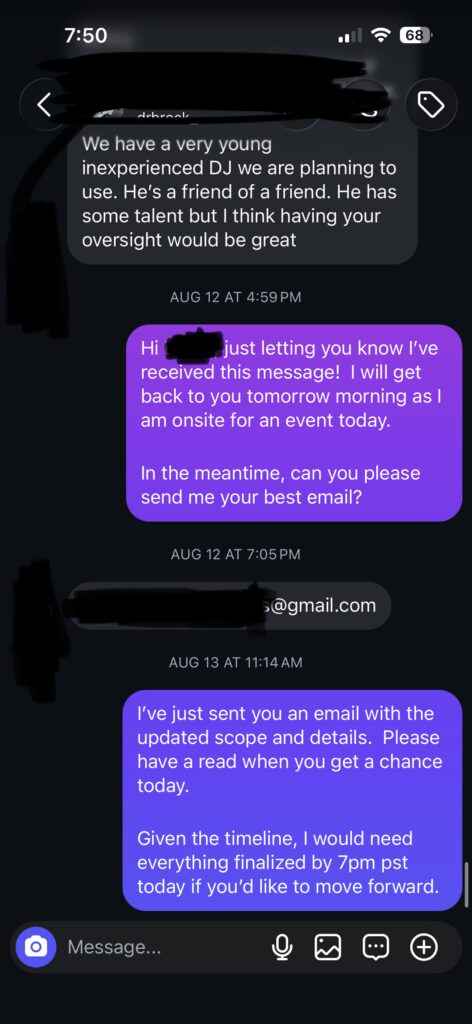
A groom had been referred to me by his wedding planner. His wedding was a little over two months away.
He told me the date and venue. I asked who his planner was and sent him my wedding inquiry form because that’s normally how I work. I want the information before we have a meeting so I actually know what we’re meeting about.
He didn’t fill it out.
And in hindsight, that’s probably more relevant to this story than I initially realized.
The lead form isn’t arbitrary. It’s there because I’m a single operator/owner running a small business with no staff.
I need certain information before I can tell you whether I’m available, whether I’m the right person, what you actually need from me and what it’s going to cost. I also need a way of collecting that information that doesn’t require me to personally walk every single inquiry through the same questions one by one. It’s unsustainable.
That’s the process.
He skipped it and we kept talking through Instagram DM instead. I didn’t stand on my professional boundary and that’s where I stopped letting my own process protect my time. In hindsight, I didn’t realize how much work I was taking back onto myself by letting the conversation continue that way.
Because I wanted to be helpful and supportive, I answered. He told me where the guests were coming from, their ages, the atmosphere they wanted, the artists they liked and how he wanted the music to feel. House-inspired, recognizable music, tasteful throwbacks. He didn’t want it to feel like an EDM event. He asked how I DJ weddings and whether I actually mix live or use curated playlists.
This is something I don’t think potential clients necessarily consider when they skip somebody’s process. The process is designed to collect the necessary information, figure out what’s missing, go backwards through messages and still put the pieces together.
One inquiry doing this isn’t going to destroy a business. But I can’t personally hand-hold every person from “Hi, I’m getting married” through figuring out what they actually need from me. That’s why the system exists in the first place.
And I participated in bypassing my own system because I kept answering.
Then I realized I was already booked on his wedding date.
My mistake.
I apologized and told him I couldn’t DJ it.
That could have been the end of the inquiry.
It wasn’t.
He told me he was genuinely disappointed because he thought I really understood what they were trying to do. He asked if I could recommend two or three DJs.
Then he told me he was learning to DJ himself and wanted to play a couple of short sets at his own wedding.
Could I help him figure out if that was realistic, coach him through the sets, help with the transitions, create a blueprint for the music, help find the primary DJ and potentially help with entertainment and AV logistics because the wedding was on an island?
(BTW – This island is also foot-passenger only. Vehicles can’t travel on this route, there’s no public transit at the terminal, some sailings require advance pickup requests, and schedules can change which is significant from an event-production standpoint.)
Okay. Now we’re not talking about me DJing anymore.
We’ve accidentally invented another job.
I told him I could come in as an Entertainment & Technical Director and help oversee the entertainment and AV side, help shape the music experience, help him navigate the DJ search and consult on his own sets.
He came back and narrowed it down. What he really wanted, he said, was help finding the DJ. Everything else was secondary and “relatively minimal.”
Then he sent me his own proposed scope: DJ search and recommendations, review of the chosen DJ, two planning calls, coaching on his own DJ sets, and a music timeline or blueprint for the evening.
I quoted $2,500 plus tax for that.
If he wanted the larger entertainment and AV coordination piece, that would be $4,500.
I explained that what he was asking for relied on my time, experience and network, and that the wedding was getting closer. He said he understood, probably didn’t need that much help, but would still really appreciate two or three DJ recommendations and would be happy to pay for a couple hours of consulting.
And then I did the thing service providers do all the fucking time.
I helped anyway.
I sent him a DJ I thought might work.
That DJ wasn’t available.
A few days later he came back and asked what I thought about another DJ.
And this part is almost funny now because he literally wrote that it would be his last “unpaid” question.
His quotation marks. Not mine.
So at that point we both apparently understood that he was asking me for something of value.
And I answered him anyway.
I told him I didn’t know enough about that DJ’s wedding work to confidently recommend them, but that there was no harm in having a conversation and seeing if they were the right fit.
Then I reminded him that if he wanted me to actually evaluate candidates and consult with him, the $2,500 option was there.
And then we didn’t speak for more than a month.
This is where the story gets interesting to me.
Because when he came back, the wedding wasn’t two months away anymore.
It was a month away.
And now there was a DJ.
Sort of.
He told me they were planning to use a “very young inexperienced DJ,” a friend of a friend, who had some talent but would benefit from my oversight.
Now he wanted the $2,500 consulting option again.
I happened to be working an event when he messaged me, so I told him I’d respond the next morning and asked for his email.
The next day I sat down and figured out what I could realistically still do.


And this matters: July availability is not August availability.
Obviously, I’m telling this from my side. I know when you’re planning a wedding you have a million things going on, on top of your actual life and work. I can understand that and still recognize that I didn’t create this urgency. By the time he came back to me, we were now trying to figure all of this out weeks before his wedding. Why?
A month had passed. I had other clients, other events and other work, and I’m now being asked to step into a wedding less than a month away with a beginner groom who wants to DJ at his own wedding and a young inexperienced primary DJ whom I don’t know.
I wasn’t going to search for DJs anymore. That runway was gone.
I could give him two 90-minute sessions, plus the preparation and review work around them. I needed his DJ confirmed. I needed information in advance. I needed quick turnaround on homework.
And yes, I wanted access to his event planner.
Because how the hell am I supposed to help design the musical flow of a wedding without knowing the actual flow of the wedding?
There aren’t two weddings. There isn’t the planner’s timeline over here and then a separate music timeline over there that I build with the groom and DJ.
If he wants to play three DJ sets, where do they go? How long are they? What’s happening around them? What has the planner already scheduled? What does the venue need? What does AV need? What has already been promised to everybody else?
You cannot ask me to think about the “emotional arc” of an evening while keeping me partially outside the evening.
This is exactly why I keep talking about bringing people into conversations earlier in my social media content because one conversation changes another conversation that can affect other vendors involved.
He pushed back on involving the planner. He said additional calls with her could increase their costs, so he wanted to know what I needed from her and whether he could provide it himself.
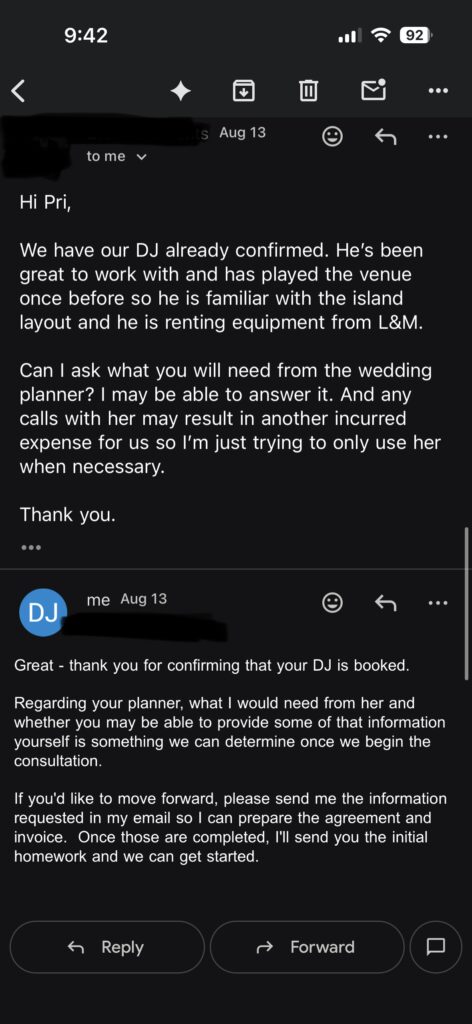
I understand wanting to control costs for your wedding.
But now I’m being asked to help with something that has to fit into a program somebody else (the planner) is already managing while not involving that person because involving her costs money to this potential client.
That doesn’t make my job smaller.
It makes it harder.
And by this point something about the whole thing wasn’t sitting right with me.
I can’t point to one message and say, Aha. There. That’s weird. That’s a red flag.
It was the accumulation.
I thought I understood the job, then the goalpost would move. First he needed a DJ. Then consulting. Then not that much consulting. Then recommendations. Then my opinion about another DJ. More than a month later there was an inexperienced DJ and I was being brought back in to oversee him.
Meanwhile, the “couple of short sets” he was thinking about playing himself had become something much more involved.
And I don’t teach DJing because I don’t have the time. But I was also starting to think, why are we doing all of this three weeks out from your wedding? A wedding is already a process. Now I’m being asked to teach the groom how to pull off three DJ sets while also mentoring an inexperienced primary DJ?
That’s not some minor little add-on.
That’s A LOT of work with a tiny runway of time to deliver and execute.
So I sent him what I could do, kept the price at $2,500, and told him I needed it finalized by 7 p.m. that day.
That deadline has become the part of this story that bothers me the most because I don’t think he understood what I meant by it.
I wasn’t telling somebody who had just arrived in my inbox that he had a few hours to decide whether I was worth $2,500.
This was August.
We’d started talking in early July.
The deadline meant: this is what I can fit into my life right now. If you want this version of it (because I’m at capacity), I need to know today.
At 1:40 p.m., he emailed me with questions.
I replied seven minutes later.
My original email had already explained that because of the compressed timeline, I couldn’t hold those consulting dates without a signed agreement and payment. If everything wasn’t completed by 7 p.m., the availability and scope were no longer guaranteed.
Seven o’clock came.
Nothing.
Then at 8:02 p.m., I got another email.


And it wasn’t an acceptance.
It was another version of the job.
Now, he explained, their needs had “evolved.”
He no longer needed help finding a DJ. He wanted me to mentor the DJ on pacing, transitions, energy management, microphone use and contingency planning.
He also wanted help building his own three DJ sets. Not just some general “what songs should I play?” conversation either. He wanted help narrowing the songs, figuring out which parts of the tracks to use, transitions, cue points, BPM, energy flow and handoffs.
Then he wanted me to review the overall music plan and emotional arc of the night.
And because the scope had changed, he asked whether the $2,500 should change too.
Now, is that an outrageous email?
No.
That’s what makes this whole thing so weird.
If somebody showed me only that email, I’d probably say: Yeah, he’s trying to clarify what he’s buying.
But I wasn’t receiving only that email.
I was receiving it after six weeks of everything else.
And it was 8:02 p.m.
I had already told him the offer expired at 7 p.m.
So the next morning I declined. I told him that I’d needed confirmation by the deadline in order to move forward and, because it had passed, I couldn’t take it on.

Eight minutes later, he told me there were “a few red flags.”

Me.
The red flag.
He said it was concerning that I’d wanted him to commit $2,500 before we’d confirmed the scope and that I’d required same-day confirmation while he was working.
And I remember basically thinking:
What the fuck have we been doing this entire time?
The same-day deadline wasn’t arbitrary urgency designed to pressure him into buying.
It was there to put an end point on how long I was willing to invest additional unpaid time while he continued deciding what he wanted from me, and whether he actually wanted to hire me at all.
It was about who absorbs the cost of somebody needing more time to figure out what they want.
Because from my side, the deadline wasn’t appearing at the beginning of an inquiry. It came after weeks of DMs, recommendations, questions, answers, different scopes, a month-long disappearance, a return less than a month before the wedding, another revised scope, an email with defined deliverables and another round of questions that I answered immediately.
His way of buying created a lot of unpaid cognitive labour for me and he didn’t appear to recognize the cumulative cost of that process to the person on the other side who had been continuing to answer, revise, think, hold capacity and wait.
At some point, I have to stop discussing the possibility of working with this person and go back to my other clients and commitments on my plate.
That’s the part I was trying to explain in the two social media videos I shared at the beginning of this blog.
I made it way too simple.
It’s not about filling out lead forms.
It’s about how hard it is to see accumulation when you’re the person doing the asking.
Nothing he asked me, on its own, consumed six weeks of my life. It’s noticing when a professional relationship is eating time when the time disappears in pieces which is much harder to see when you’re in it, easier to see looking back.
A DM here. A thoughtful answer there. Look at this DJ. What do you think about this? What if we did this instead? Could the planner stay out of this part? We found somebody. Actually, here’s what we’d like you to do with him. And by the way, the wedding is now a month away. And these questions – all from one potential unbooked client.
None of those messages arrives with a label saying:
YOU ARE NOW DOING UNPAID WORK.
It just accumulates.
And I was part of creating that situation too.
The first time he skipped my process, I accommodated it.
Then I kept accommodating the conversation because I was trying to be helpful. A people pleaser.
That’s how you end up hand-holding something you specifically built a process so you wouldn’t have to hand-hold.
And that’s not sustainable.
A business can’t depend on the owner personally carrying every prospective client from “Hey, I’m getting married” all the way to “Okay, here’s what you actually need.”
Not while also doing the work people have already hired them to do.
The process isn’t there to make the relationship less human.
It’s there so the human doesn’t have to become the process.
Then I did something I probably shouldn’t have done.
Weeks later, I looked up the wedding.
I wanted to know what happened.
Was this event even real? Did he actually get married there? Because some part of me thought that he might’ve been a scammer.
Who did they hire? Did this whole complicated thing work?
And there it was.
Beautiful.
Like, beautiful beautiful.
The kind of wedding where you look at the pictures and immediately start questioning your own memory of the entire interaction.
I recognized some of the vendors. The venue looked incredible. Everything looked polished.
And my brain immediately did the thing brains do:
Did I fuck this up?
Did I read him wrong? Was I too rigid? Was the deadline stupid? Should I have just waited another hour? Did I walk away from something that would have been great?
And this is where I have to catch myself.
Because I don’t know.
Maybe everything was wonderful and I completely misjudged the whole thing.
But my gut was reacting to the pattern, not one smoking gun.
Nothing he did individually was necessarily outrageous. That’s partly why I kept questioning myself. This wedding inquiry kept requiring me to recalculate what I thought was happening.
I saw six weeks of my attention disappearing into something that still wasn’t a job, a shrinking runway, an inexperienced DJ, a groom who wanted me to help teach him to DJ three sets, a planner I needed access to and a scope that wouldn’t stop moving.
We were looking at the same potential job and seeing completely different things.
Weeks later I looked at a handful of beautiful photographs and wondered whether declining that wedding was the “right” decision in some objective, provable way.
I don’t think there is one.
I know that by the time I declined it, I didn’t trust the working situation enough to enter it.
That’s what I’ve actually been trying to say this whole time.
Not “fill out my inquiry form.”
Not “respect service providers.”
Not “my time is valuable.”
Those are all true, but they’re too easy.
The harder thing is noticing how much of another person’s time, attention and judgment you’re already using while both of you are still pretending nothing has started yet.
Part of why this exchange bothered me so much is that I’d already given this person so much of my energy and time. Those weren’t throwaway responses. I was thinking about his wedding, giving thoughtful answers, making recommendations and trying to help him figure it out. That time came out of other work I could have been doing. He’d already skipped the process I created to avoid exactly this kind of hand-holding, and I let him. Then after all of that, I was the red flag. It just didn’t feel fair.
And if you’re the service provider, maybe there’s another question sitting beside it:
How much are you giving away while telling yourself you’re just being helpful, heart-centered or human?
You can see the time somebody gives you. You can’t see what they gave up to give it to you, is one of the central discoveries of this entire case study.
Because opportunity cost is the business-school word for it, but that’s not how it feels when you’re living it.
That’s what a work system process is supposed to protect you from in the first place. It feels like: I spent 45 minutes thinking carefully about your wedding, and nobody can see the thing I didn’t get to do during those 45 minutes.
Multiply that across inquiries, “quick questions”, DMs, proposals, revisions, recommendations, calls, people bypassing your intake system – and suddenly you understand why a business owner can become resentful even though no single person asked for anything outrageous.
Pri.